


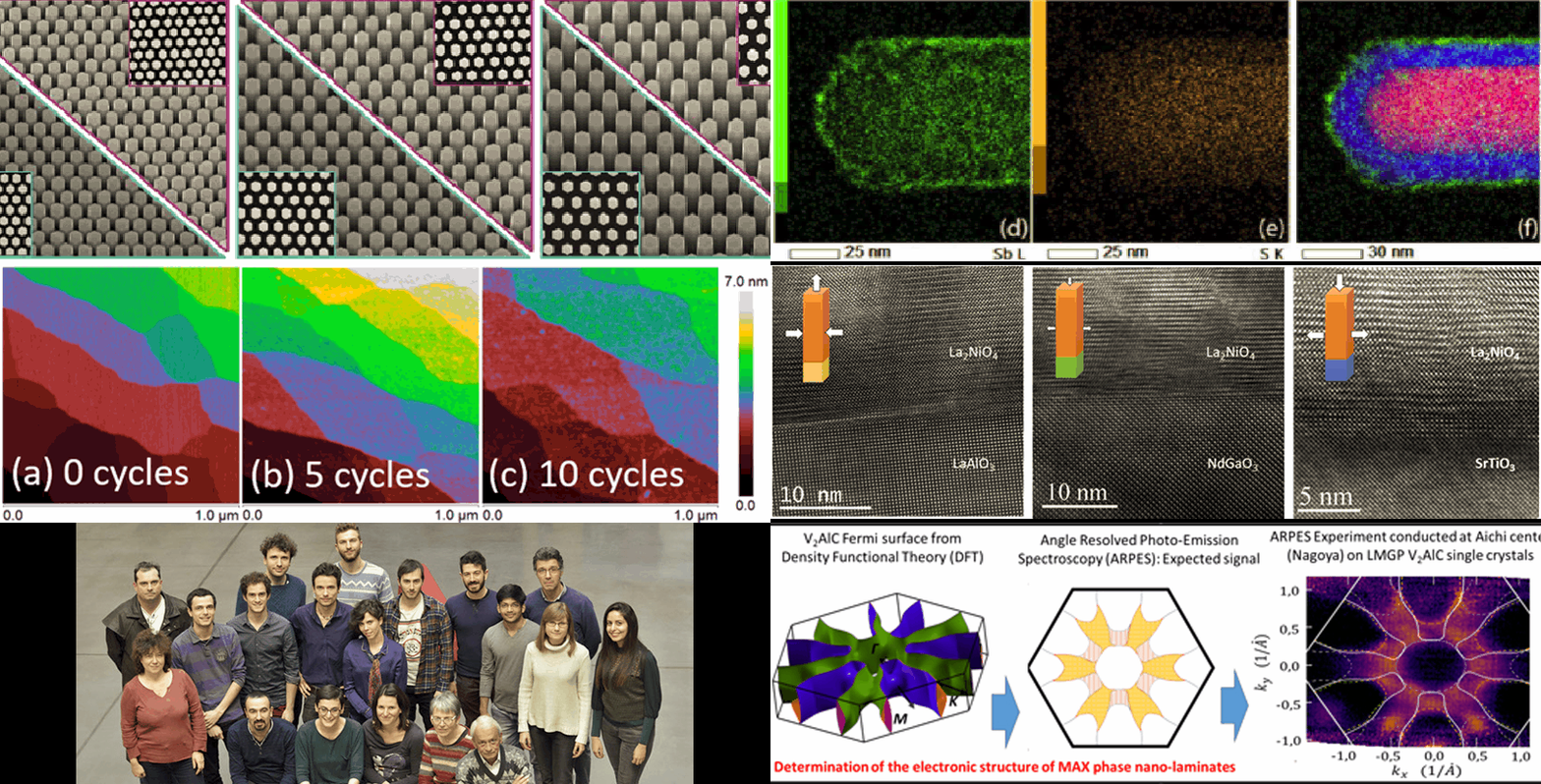
The research activities of Nanolamellar and 2D Materials axis is dedicated to:
i) the growth of single crystals of nanolamellar compounds, particularly MAX phases, via high-temperature solution growth to obtain high-quality macroscopic crystals;
ii) the synthesis of 2D transition-metal carbides and nitrides (MXenes) through wet-chemical or molten-salt etching routes;
iii) the growth of 2D metal disulfides ultra-thin film heterostructures using Atomic/molecular Layer Deposition processes to enable upscaling and control of thickness at the nanometer scale
In the context of MXene synthesis, we focus on tailoring and controlling surface functional groups both directly during etching and through post-synthetic modification. For 2D disulfides, our research aims to achieve a detailed understanding of the chemical and structural mechanisms governing the key steps of growth, enabling improved control over the crystallinity and properties of the resulting materials.
A substantial part of our research relies on large-scale instrument facilities to probe the intrinsic structural, electronic, and chemical properties of nanolamellar and 2D materials. We widely use ARPES measurements on MAX-phase single crystals, combined with DFT calculations, for detailed investigation of their electronic band structure. XAFS is employed to resolve the local coordination environment and oxidation states within MAX phases, MXenes and 2D sulfides, while XPS and valence-band XPS are used to monitor surface chemical transformations in MXenes under controlled atmospheres or external stimuli. As for ALD/MLD synthesis, we use a dedicated reactor that enables in situ optical analysis (ellipsometry) and chemical analysis (residual gas analysis) as well as and in situ synchrotron X-ray studies (XRF, XAFS, XRR, XRD). Laboratory-based analytical techniques (TEM, XRD, XRF, Raman spectroscopy, XPS) are regularly used to establish structure-property correlations.
Permanent Staff
Maksim Riabov (PhD)
Gabriel Prado da Silva (PhD)
5 selected publications
[1] T. Ito et al. Physical Review B 107, 235145 (2023)
Electronic Structure of the Surface States of the Zr3SnC2 MAX Phase
[2] H. Pazniak et al. Open Ceramics, 18, 100579 (2024)
Electronic and Thermal Properties of Nb2CCl2 MXenes
[3] T. Ouisse et al. Physical Review B 112, 035149 (2025)
X-Ray Linear Dichroism in Ti3C2Tx
[4] P. Abi Younes et al. Chem. Mater. 34, 10885 (2022)
Transition Metal Dichalcogenide TiS2 Prepared by Hybrid Atomic Layer Deposition/Molecular Layer Deposition: Atomic-Level Insights with In Situ Synchrotron X‑ray Studies and Molecular Surface Chemistry
[5] A.-K. Yadav et al. Nanoscale 16, 1853 (2024)
Quantitative in situ synchrotron X-ray analysis of the ALD/MLD growth of transition metal dichalcogenide TiS2 ultrathin films
Electronic Structure of the Surface States of the Zr3SnC2 MAX Phase
[2] H. Pazniak et al. Open Ceramics, 18, 100579 (2024)
Electronic and Thermal Properties of Nb2CCl2 MXenes
[3] T. Ouisse et al. Physical Review B 112, 035149 (2025)
X-Ray Linear Dichroism in Ti3C2Tx
[4] P. Abi Younes et al. Chem. Mater. 34, 10885 (2022)
Transition Metal Dichalcogenide TiS2 Prepared by Hybrid Atomic Layer Deposition/Molecular Layer Deposition: Atomic-Level Insights with In Situ Synchrotron X‑ray Studies and Molecular Surface Chemistry
[5] A.-K. Yadav et al. Nanoscale 16, 1853 (2024)
Quantitative in situ synchrotron X-ray analysis of the ALD/MLD growth of transition metal dichalcogenide TiS2 ultrathin films
Projets
ANR-DFG MAGMXENES (2023-2027, coordinateur)
Type : Agence Nationale de la Recherche, appel PRCI
Titre : Ingéniérie des Propriétés Magnétiques des MXènes Bidimensionnels
Partenaires : University of Duisburg-Essen (Germany), ESRF (Grenoble)
SIN-2D (2025-2028, coordinateur)
Type : ANR, ANR-25-CE09-7993,)
Titre : Smart Integration of 2D semiconductors
Partenaires : Leti, Grenoble ; synchrotron SOLEIL, Saint Aubin (91)
Type : Agence Nationale de la Recherche, appel PRCI
Titre : Ingéniérie des Propriétés Magnétiques des MXènes Bidimensionnels
Partenaires : University of Duisburg-Essen (Germany), ESRF (Grenoble)
SIN-2D (2025-2028, coordinateur)
Type : ANR, ANR-25-CE09-7993,)
Titre : Smart Integration of 2D semiconductors
Partenaires : Leti, Grenoble ; synchrotron SOLEIL, Saint Aubin (91)
Collaborations nationales & internationales
- Institut Néel, Grenoble
- European Synchroton Radiation Facility, Grenoble
- SOLEIL, Saint Aubin
- Institut Laue-Langevin, Grenoble
- Institut Pprime, Poitiers
- ICMCB, Bordeaux
- University of Duisburg-Essen, Germany
- University of Tor Vergata, Italy
- UCLouvain, Belgium
- Synchrotron Solaris, Poland
- Synchrotron Elettra, Italy
- CNR-ISM, Italy