Laboratory in Materials Science and Physical Engineering
Paper by Soline Beitone
The paper intitled "Mechanisms involved in the hydrothermal growth of thin and long
Cu2O nanowires" has been published in Materials Today Chemistry
to
Iere you will find the article by Soline Beitone
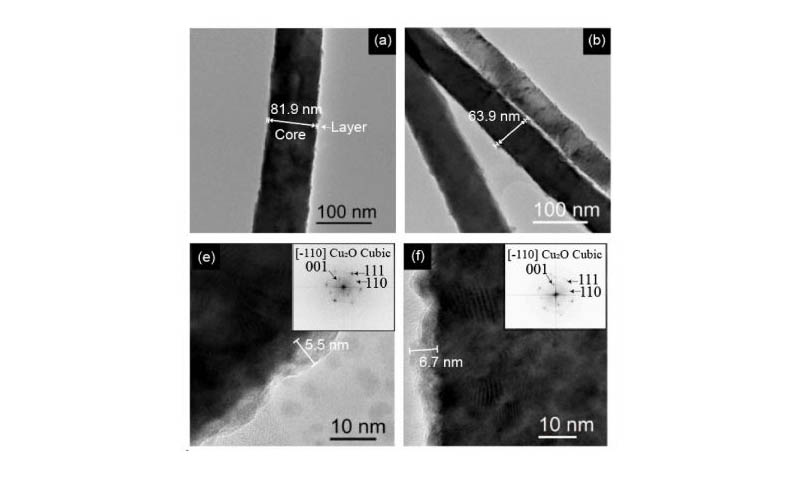
"We report a facile hydrothermal synthesis strategy for producing long and thin Cu2O nanowires leveraging the redox chemistry of Fehling’s reaction. By systematically varying reaction temperature and time, we modulate supersaturation levels and growth kinetics, achieving tunable aspect ratios ranging from 43 to 170. Scanning and transmission electron microscopy (SEM and TEM) analyses reveal that nanowire elongation occurs under a kinetically controlled regime, predominantly influenced by redox-driven nucleation behavior. Critical thresholds of temperature and duration are identified, beyond which auto-reduction processes lead to the formation of nanoparticle-like aggregates, thereby compromising structural uniformity. Automated Crystal phase and Orientation Mapping (ACOM) with precession (ASTAR) system and X-ray photoelectron spectroscopy (XPS) reveal the formation of a thin, disordered Cupric oxide (CuO) surface oxide layer, indicative of progressive partial oxidation. The thickness of this oxide layer increases with both temperature and reaction time. Notably, prolonged aging and higher temperature in the alkaline medium accentuates this transformation, leading to the emergence of CuO phase. These findings provide qualitative insights into the coupled roles of growth kinetics, redox equilibria, and surface phase transitions in governing the morphology and stability of Cu2O nanowires synthesized under mild, static conditions"