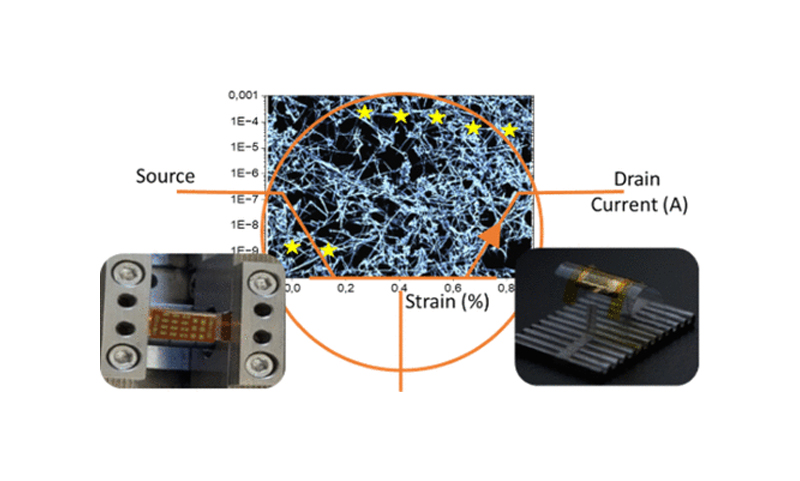
Le papier "Emergence of Collective Piezotronic Behavior in Randomly Oriented Semiconducting ZnO Nanowire Networks for Flexible Devices" a été publié dans ACS Applied Nano Materials
au
Ici vous trouverez le papier de Céline Ternon
"Since the discovery of the piezotronic effect─arising from the coupling between piezoelectricity and semiconducting properties─most studies have focused on single nano/microstructures or thin films. Here, we report the first experimental evidence of piezotronic behavior in devices based on ZnO nanonets integrated on flexible Kapton substrates. These nanonets consist of two-dimensional networks of randomly oriented ZnO nanowires, with no preferential alignment of the c-axis. The devices were subjected to controlled mechanical loading, including uniaxial tension and bending, under both tensile and compressive strain. We show that the first application of tensile strain above a critical threshold (∼0.3%) induces an abrupt increase in conductivity by 3 to 8 orders of magnitude. This behavior is attributed to the strain-induced subdivision of the nanonet into two effective subnetworks with opposite c-axis orientations, combined with the suppression of potential barriers at nanowire–nanowire junctions by the piezopotential. Upon further elongation, the electrical response becomes dominated by piezoresistive effects. As a proof of concept, mechanically gated transistors based on ZnO nanonets were demonstrated and directly compared with conventional potential-gated transistors. The mechanically gated devices exhibit an ON/OFF ratio approaching 108 for strains as small as ∼0.4%, whereas an ON/OFF ratio of only ∼105 is obtained in a back-gated configuration under a gate voltage of −65 V. These results demonstrate that randomly oriented nanowire networks can sustain strong piezotronic effects, paving the way toward robust, flexible devices based on collective nanostructures rather than single elements."