Paper by Soline Beitone 2026

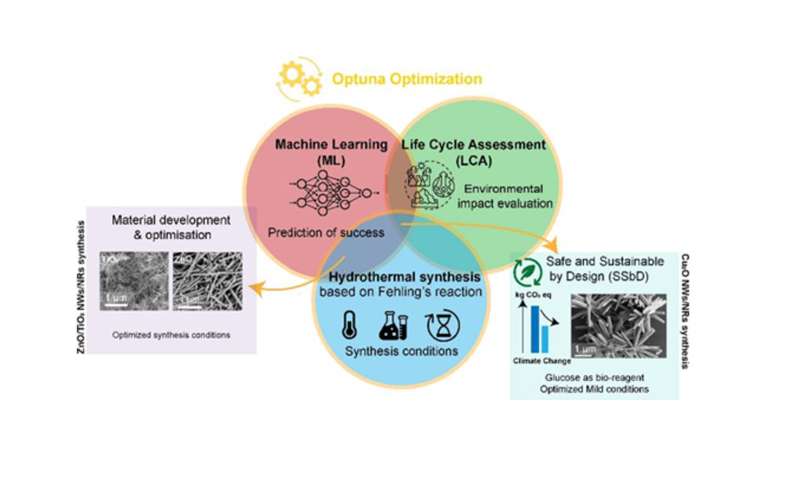
The paper "Integrating Machine Learning and Life Cycle Assessment for Fehling-Inspired Sustainable Synthesis of Cu2O Nanowires and ML-Guided Design of Metal Oxide Nanorods" has been published in ACS Applied Nano Materials

    • to
You will find here  the link to the paper by Soline Beitone
"Designing nanomaterials with precise morphology while minimizing environmental impact remains a central challenge in sustainable materials chemistry. Here, we present a data-driven framework that integrates Life Cycle Assessment (LCA) with Machine Learning (ML) and optimization via the Optuna algorithm to advance the Safe and Sustainable by Design (SSbD) synthesis of Cuprous Oxide (Cu2O) nanowires (NWs) and nanorods (NRs). The hydrothermally synthesized Cu2O nanostructures, where glucose was used as a biobased reducing agent under mild and environmentally benign conditions, serve as a case study for ML–LCA integration. Four ML models: Naïve Bayes (NB), Random Forest (RF), Support Vector Machine (SVM), and Multi-Layer Perceptron (MLP), were trained to predict the probability of successful one-dimensional nanostructure formation. Building upon this Cu2O framework, the same ML-guided prediction strategy was successfully extended to design Fehling-inspired Zinc Oxide (ZnO) and Titanium Dioxide (TiO2) NWs/NRs. This study demonstrates a proof of concept for an integrated framework that combines ML and LCA with optimization algorithms, such as Optuna, to systematically minimize experimental trial and error. By coherently linking synthesis design, environmental performance evaluation, and data-driven optimization, the proposed approach enables adaptive decision-making and significantly enhances ecoefficiency in nanomaterial development. Importantly, this framework operationalizes the SSbD paradigm by embedding sustainability into early-stage material design.."