Paper by D.Muñoz-Rojas in collaboration with INMA

The paper "Impact of different laser annealing regimes on the structural, chemical and morphological changes of Cu2O films"has been published in Applied Surface Science Advances

    • to
Here you will find D. Muñoz-Rojas' paper
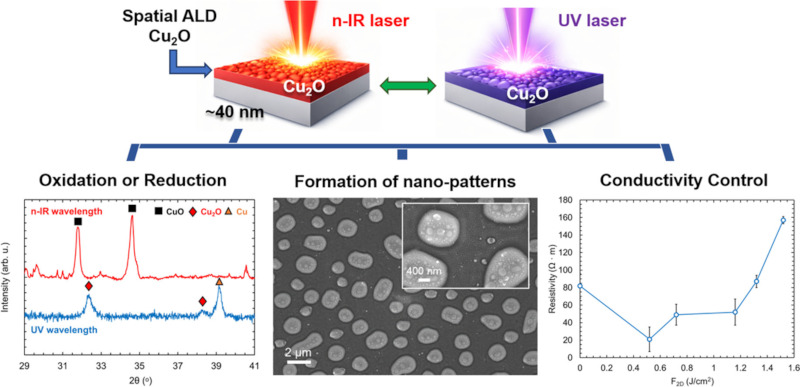
"This work presents a comprehensive investigation of the structural, chemical, morphological, and electrical modifications induced in Cu2O thin films deposited by Spatial Atomic Layer Deposition (SALD) following laser thermal annealing (LTA) in air. The results provide insight into scalable approaches for the precise engineering of oxide semiconductors, with direct relevance to emerging applications in optoelectronics, catalysis, and energy conversion technologies. Two complementary irradiation regimes were explored to decouple thermal and photochemical effects: a near-infrared (n-IR) nanosecond laser (1064 nm, 20 ns) and an ultraviolet (UV) picosecond laser (355 nm, 300 ps). Synchrotron-based XRD, XANES, and EXAFS analyses reveal that n-IR irradiation operates in a thermally dominated regime, inducing oxidation of Cu⁺ to Cu²⁺ and the formation of CuO through extended heat diffusion and grain coarsening. Conversely, UV picosecond irradiation confines excitation to the near-surface region, enabling localized recrystallization and texture reorientation of Cu2O without altering its oxidation state. At higher fluences, partial photoreduction to metallic Cu can be promoted. Scanning electron microscopy images display wide heat-affected zones and heterogeneous morphologies in n-IR irradiated samples. In contrast, UV processing achieves precise surface control, from smooth, compact films to distributed 3D nano-hemispheres, through tunable melting and re-solidification. Electrical measurements reveal that low-energy UV treatments reduce film resistivity by a factor of four, whereas n-IR irradiation suppresses macroscopic conduction through the formation of insulating CuO. High-fluence UV irradiation disrupts film continuity and eliminates lateral percolation. Overall, these findings establish laser engineering as a robust, single-step, and scalable approach for the bidirectional tuning of Cu2O thin films, enabling oxidation or reduction, and morphological control critical for next-generation optoelectronic, catalytic, and energy-conversion devices."