Paper by Charlotte Vendrely

The paper "Unveiling the Interactions between a Protein Derived from Barnacle Adhesive and Surfaces Using Surface Plasmon Resonance Imaging" has been published in ACS Applied Bio Materials
    • to
Here you will find the paper by Charlotte Vendrely
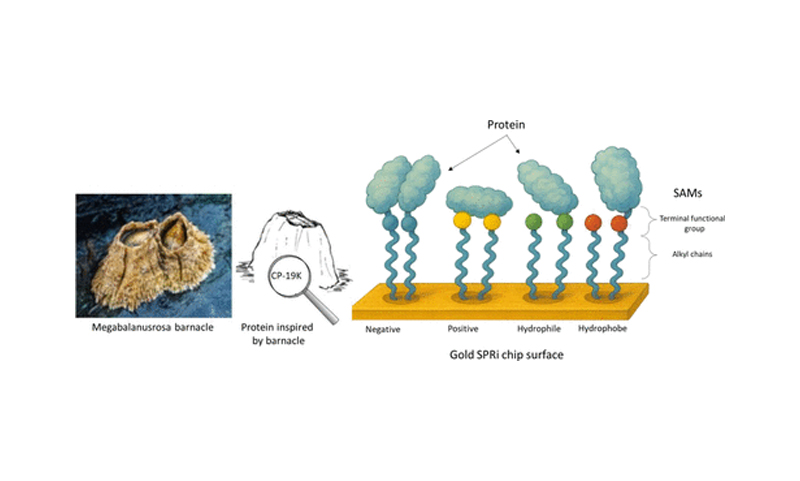
"Protein adsorption at interfaces is an important fundamental phenomenon that occurs in both natural and engineered systems. Despite recent advances in research on protein-interface adhesion, a lack of understanding persists regarding the interactions that occur on different surfaces and under various conditions, including pH, ionic strength, and temperature. Barnacle-inspired proteins are as promising biomolecules for investigating bioadhesive properties in wet conditions, since their natural adhesive mechanisms provide valuable insights into surface interactions. In this study, a recombinant protein called M19-2, inspired by the sequence of the barnacle protein Mrcp19, was produced in Escherichia coli and purified. The adsorption behavior of M19-2 on relevant self-assembled monolayer (SAM) surfaces with various physicochemical properties was studied using surface plasmon resonance imaging (SPRi). The present work investigated the effects of pH, temperature, and ionic strength on its binding characteristics. The results were then compared to those of model proteins, including human Fibrinogen, bovine serum albumin, and lysozyme. It was demonstrated that the M19-2 presented higher adsorption at an acidic pH compared to a neutral and basic pH, across various surfaces with different physicochemical properties. Moreover, temperature, ionic strength, pH, and protein concentration all affected the protein adsorption on different surfaces. Notably, the M19-2 exhibited stronger adsorption relative to its size compared to the selected model proteins. By addressing the existing gaps in the field of protein adsorption studies, this research provides valuable insights into protein-interface interactions, contributing significantly to the advancement of our understanding of bioinspired adhesive materials."